
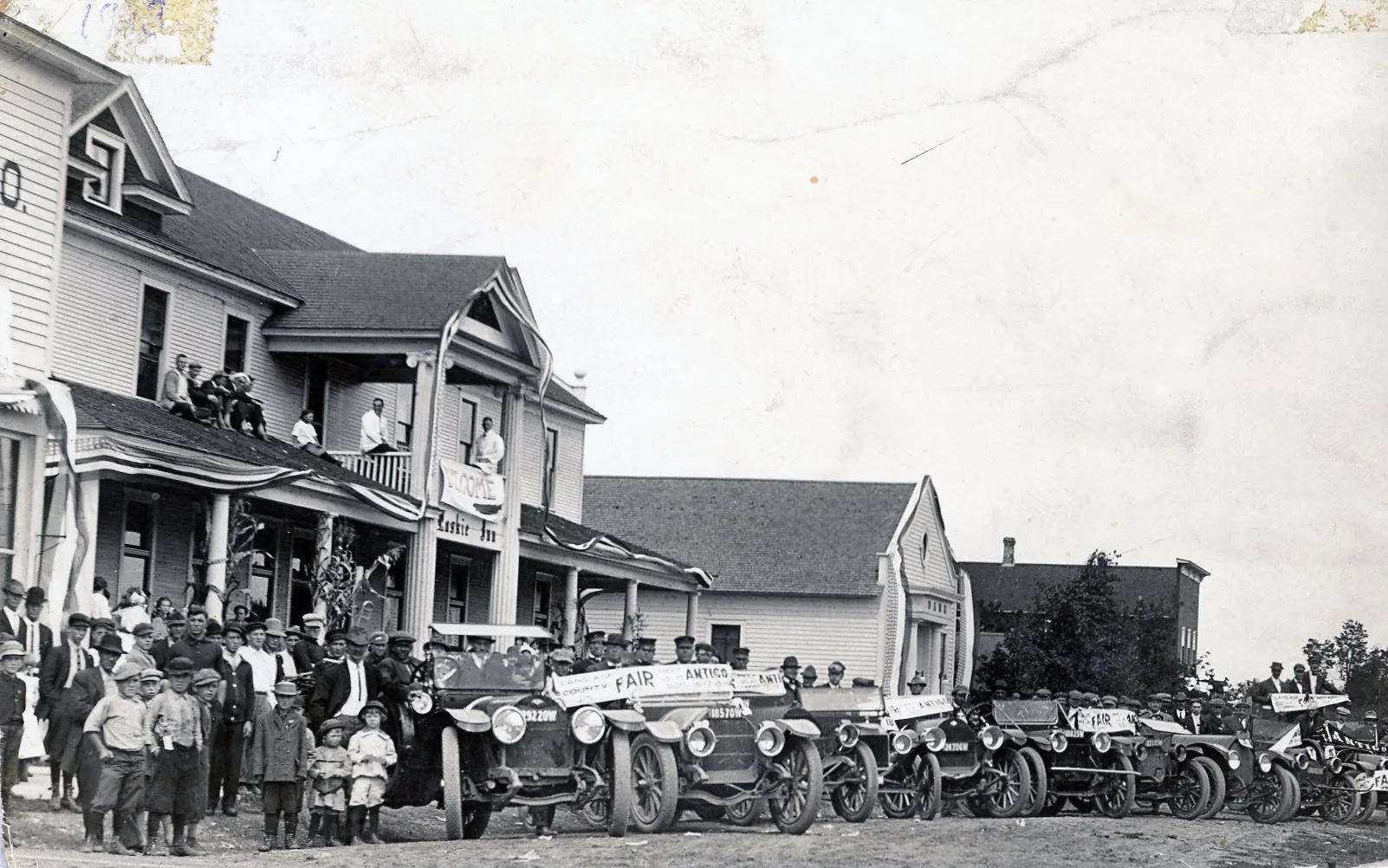
1913 Langlade County Fair Promotion
By Bear Wheeler
When one wonders about the past and what it would’ve been like, you must consider that they had no idea of our modern conveniences. People then, as now, only know what their parents taught them and by their own experiences. I like to think back about what it was like to live in this area in its true heyday. The early 20th century was the same in most places in this part of the country. Most of the area was all majestic stands of White Pine trees are now cut over and shrubs. It was in this time, that the hardwood stands were being harvested, for furniture and flooring. I know this sounds like it was a free for all, but it was in this era (1870-1920) that our cities were really expanding, and the thirst for more wood was there.
It was in this time frame of 1910-1920 that Elcho and the surrounding area were still logging and were transitioning into an agricultural area. Once the trees were gone, the men looked to the soil and found that the soil here in Langlade and Oneida Counties, was a sandy clay loam, ideal for planting.
Farmers from the southern regions had hard, heavy clay soil to work, and the soil here had a higher degree of sand to make it easier to work thus more profitable. Word was getting around, that men, with land that had planted potatoes, that it was possible to pay off their land in one growing season selling their potatoes.
Growing cities down south, like Chicago, were consuming potatoes quickly. The Follstad brothers and Charles Beard had to fill cellars with their crops of potatoes, for the local consumption and seed for the following year.
Take this into account that barns were popping up all over due to the fact of the success of farming here then, this alone commanded much wood for the sawmills.
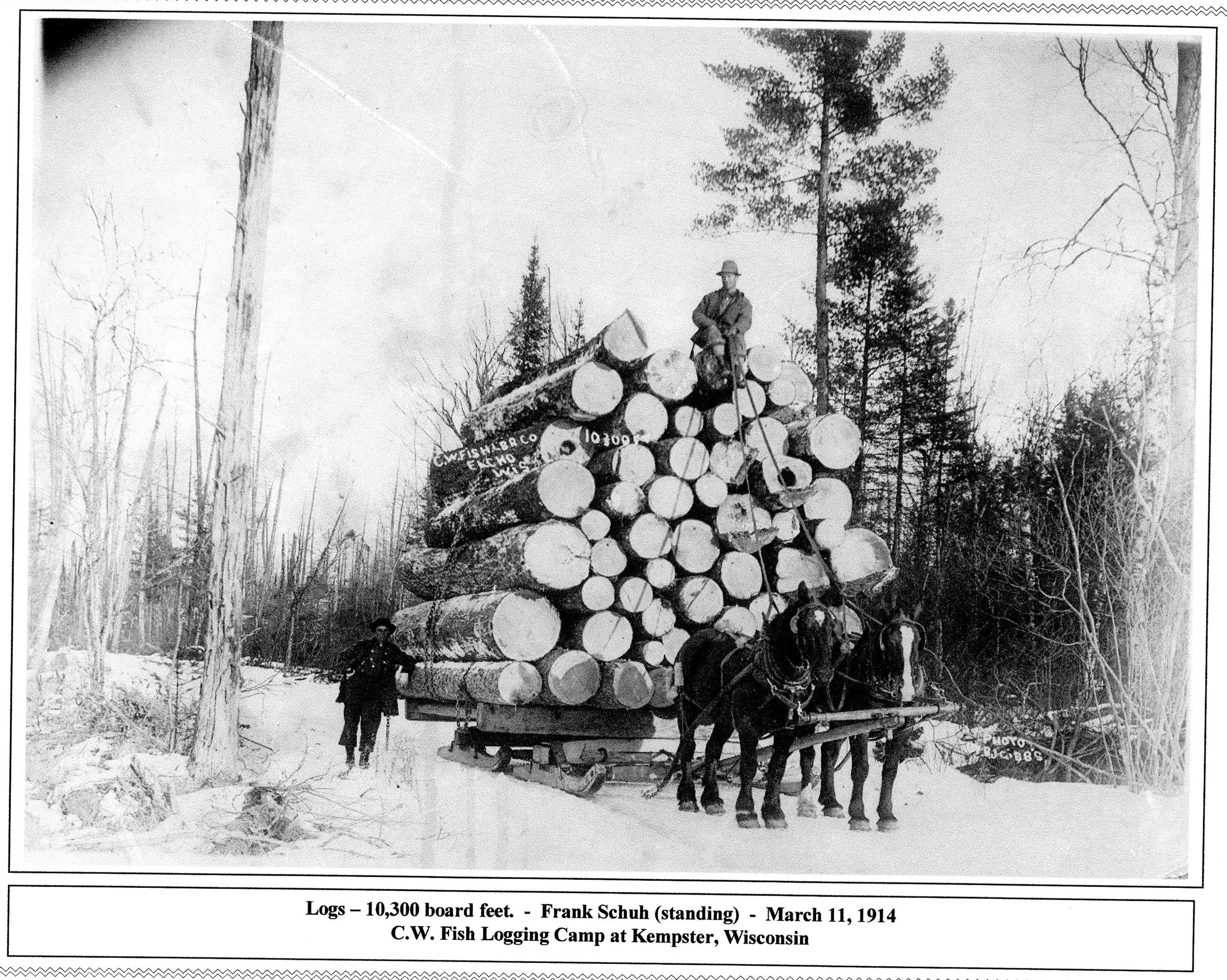
March 14, 1914 - Charles W. Fish Logging Camp at Kempster, Wisconsin - Logs 10,300 board feet
Charles W. Fish was our lumber baron, and he had owned many sawmills in different towns, at the same time, being based in Elcho, he had brought many people to the area for work. Fish had built a furniture company here in Elcho, as well as the sawmill and planing mill that was here.
The sawmill provided electricity to power themselves, to the Muskie Inn, and lighted up the village with cluster lights.
Elcho was quite a modern town. In all, Elcho boasted two hotels and two general stores that were touted as being the best in the county. There were several blacksmith shops, a four-department graded school, and Catholic and Protestant churches, something to meet everyone’s needs. The people that lived here in this time were industrious, progressive, and kind, this is where Elcho gets its tagline, “a progressive community.”
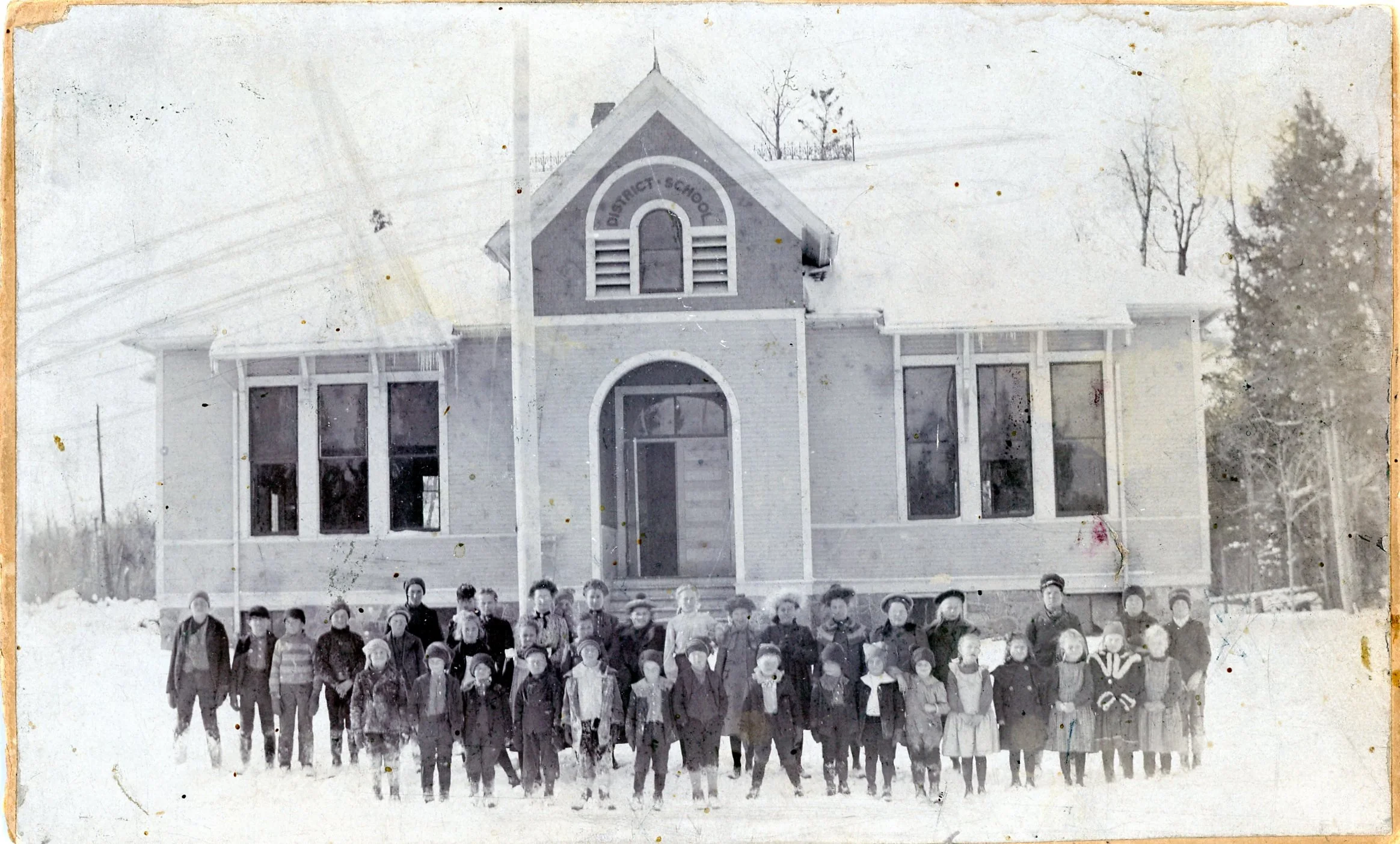
The School in Elcho during those years
In this era, Elcho had no saloons or drinking establishments, Charles Fish was not given to alcohol. He had much control of how things were run around here, but there were saloons in Pelican Lake, Jennings, Lenox. Mr. Fish paid his employees with his own tokens, known as “Fish money.” It had to be spent at his general store and other businesses that accepted it. This practice would keep as much of the money locally as possible. Some people didn’t like him and some people did, but in his defense whenever disaster struck, he cured the situation. Fish also attracted notable people to the area because of his vision and drive. As long as the timber held out, so did Charles W. Fish.
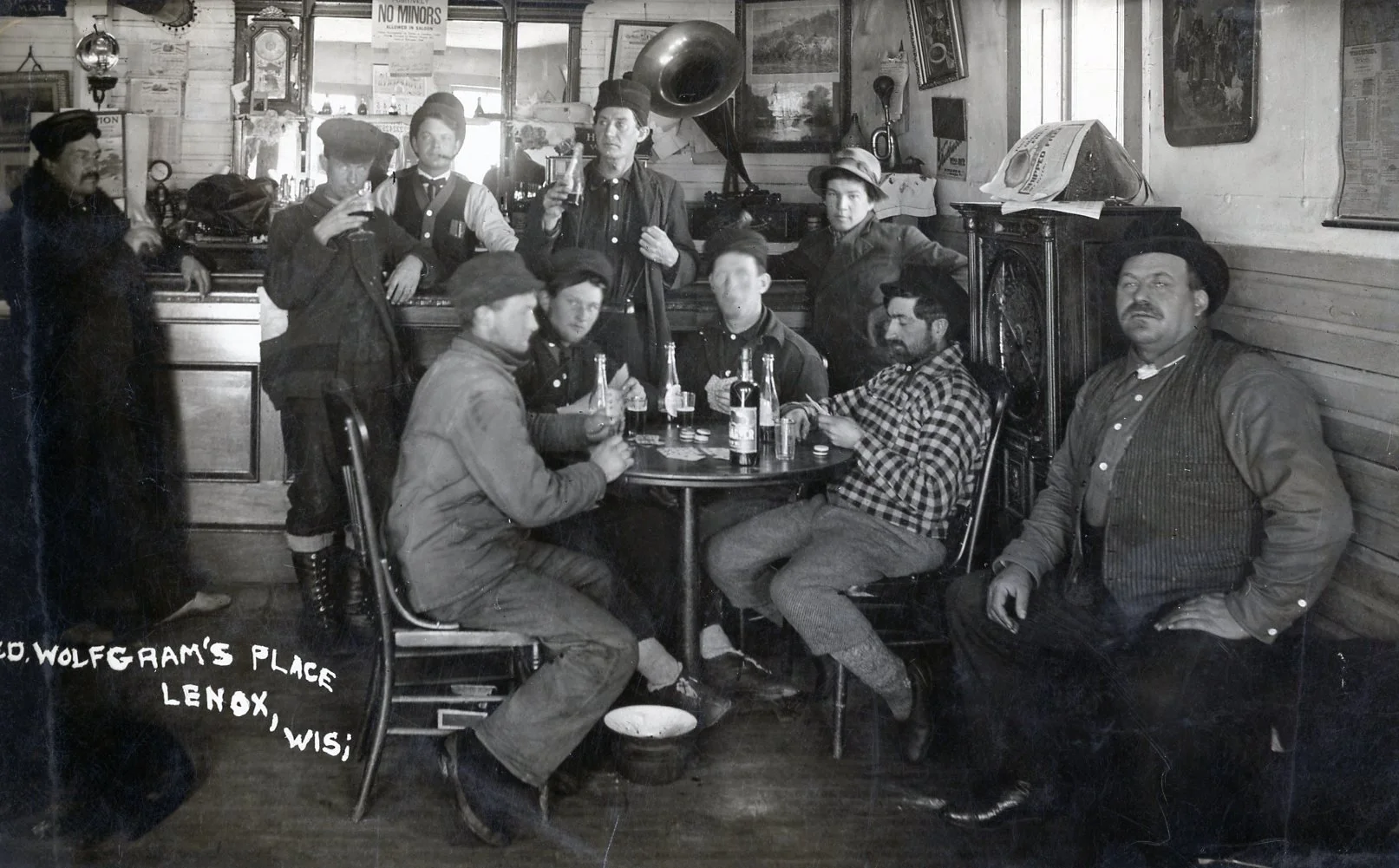
J. D. Wolfgram’s Place - Lenox, Wisconsin
People here would go places easier, then one might think.
This town was connected to others by the Chicago-Northwestern Railroad daily passenger trains going both north and south a couple times a day. A trip to Antigo or Rhinelander would not be a hard thing. I have seen letters and postcards from people traveling the country in those days and post cards were delivered like phone calls, so, the system was very efficient. There were people around that had Ford Model T’s and other comparable vehicles, but mind you, the roads. The roads were actually wagon trails and based on weather conditions stretches of them could become mud pits and these areas would have logs or railroad ties laid out to bridge over the mud. Many stories of people getting stuck in between Elcho and Pelican Lake had their vehicles pulled out by the Boettcher family’s team of horses. People who had vehicles this early in this area are Charles Fish and Bernhard Follstad. I know a little later in the early 1920’s Elcho had a Ford dealership right in town.
The horse and buggy, or a team of horses and a wagon, wasn’t the cheapest mode of transportation either. One or two horses need to eat every day and have shelter. A good walk was the cheapest way to get around. Many little towns or villages were designed at four miles apart, give or take, so the furthest a person had to walk was two miles respectively. Let’s think about this area to put this in perspective. Going south from Elcho, there is Summit Lake, Koepenick Siding, Kempster, Neva. Heading north there’s Pratt Siding (before 1910), Pelican Lake, Enterprise, Monico. Going eastward there’s Post Lake, Swamp Creek, Jennings/Lenox, Nashville, Pearson, Pickerel, Lily, and so on. People were quite connected because of their proximity to people who provided services to them. The one thing that was scarce in this particular area were banks, other than Elcho, Antigo, Rhinelander and Crandon, this would take a trip to go handle financial needs.
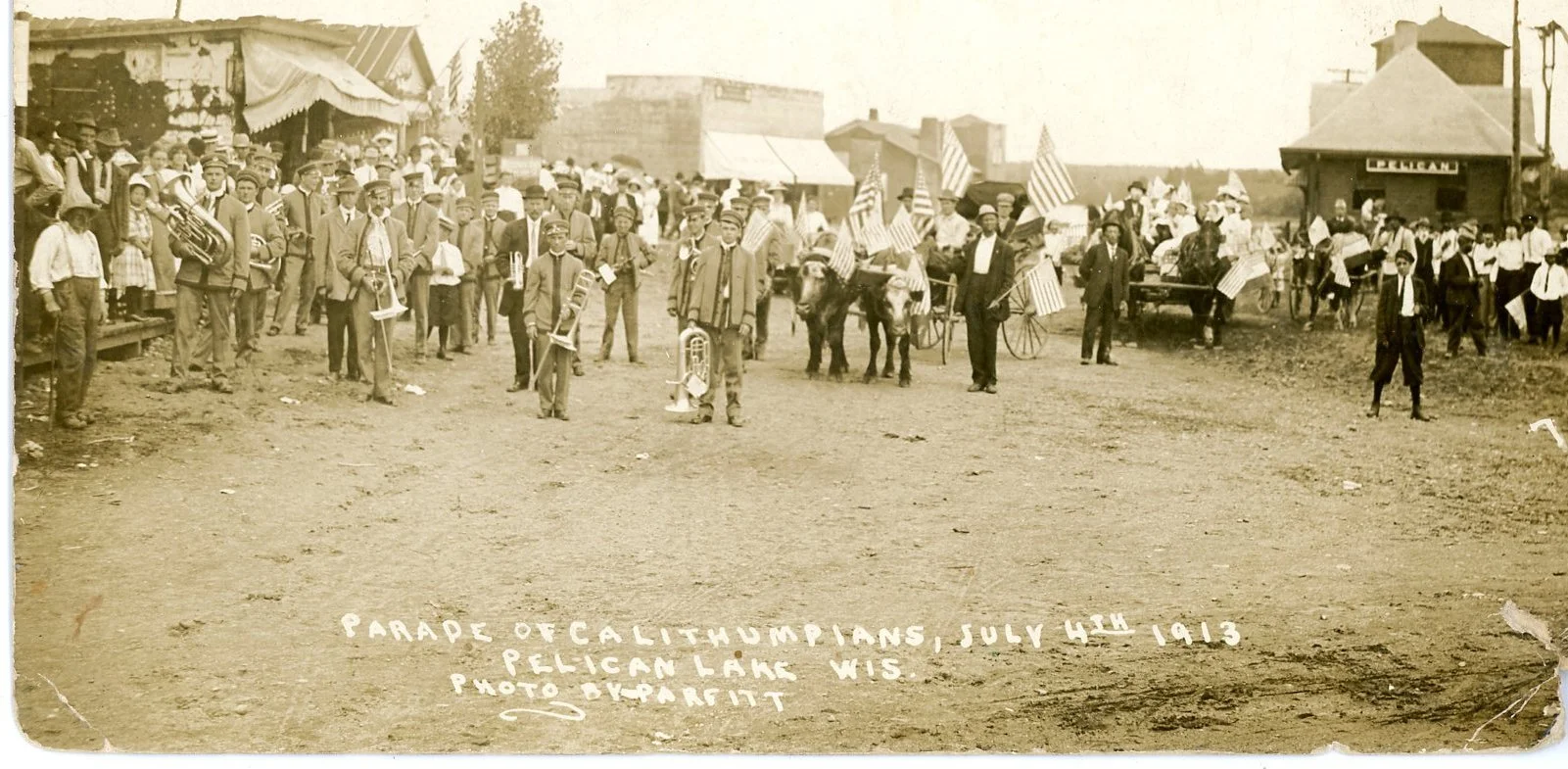
Pelican Lake Celebration July 4, 1913
Now to get to a broader view of what was happening from 1910-1920. Newspapers were a big thing in those days, it was the internet of today, being the tool to bring people the events happening around the world. Being on a farm in Jennings, Wisconsin, in April of 1912, the news of the Titanic’s sinking and huge loss of life would’ve got there that Tuesday or Wednesday, after the ship sank in the early morning hours of Monday morning. News like this was discussed between neighbors, friends at the saloons, work places and such.
From 1914 on, the news of war was in the headlines regularly and the young men probably viewed the war with a degree of romanticism because of chivalry, sweeping cavalry charges, and quick glory from stories shared from the American Civil War. But as the war dragged on, and hearing things like, machine guns, flamethrowers, poison gas, and submarine warfare shocked American boys from romanticism to an anti-war sentiment.
Then with the sinking of the Lusitania and unrestricted submarine warfare made the concept of American involvement more probable. The newspapers and posters would have driven the point of patriotism to the young men to get them mentally ready for enlistment, to the tune of “If somebody doesn’t stop the Germans, they will be here.” Once the American boys got there, it was already a “meat grinding” machine to say the least. American soldiers who didn’t pay with their life took home a psychological payload of trauma and shock to deal with the rest of their lives. They tried their best after that to be men, have jobs, raise a family, and pretend that nothing was wrong. Some didn’t make it, many died by their own hand, or were tyrants as husbands and fathers, because they didn’t know how to deal with their experiences, turning to the bottle to try to erase those memories.
This generation experienced many hardships, which didn’t stop with the closing of World War One. As the guys were coming home, a global pandemic struck in late September of 1918, at the Great Lakes Naval Training Station in Illinois, and the outbreak spread to Milwaukee. What was shocking about this outbreak is that it struck young, healthy adults by pulmonary edema (lungs filling with fluid), people from ages 15-40 were suddenly collapsing and then dying after 24-48 hours. This created widespread panic and the Health Department shut down everything across Wisconsin to try to prevent the spread. As the War ended in November of that year, the virus spread even faster. Waves of infections happened in 1919 to 1920, taking many people in its wake. When you walk through cemeteries, even in this area, you can see many people who died in the 1918-1920 years. In regards to the living, because this flu targeted people from 15-40, many families suffered the loss of both parents leaving the children orphans. Orphanages and extended families had to cover for this influx of dependents for the next several years.
Coming back to local events, other than the war and the flu outbreak, the Elcho area was the place to be. In this period of time Elcho and Pelican Lake were growing in population, whereas other towns were stagnant. Businesses were being started at a quick pace and as previously noted, Charles W. Fish had a big hand in this happening. He had a knack for catching the “next big thing.” In 1911, he had built the first “Muskie Inn” right in front by the depot, so everybody going by on the train saw this beautiful, grand, white building, which caught attention. This building had a soda fountain, a billiard room, and a barber chair. It had electric lights that used electricity from the sawmill, so the lights were only on when the sawmill was operating, which sounds like an inconvenience, but most businesses only had kerosene lamps, especially in this part of the country. This motel did not have indoor plumbing like the later Muskie Inn. Fish’s business was going strong as there was still hardwood to attain in the area, to keep his mill running. He would have large Lumberman’s Conventions at the Muskie Inn, which would bring all the big lumber personalities from across the state and the Upper Peninsula of Michigan.
Then in 1912, the Elcho State Bank was chartered to serve the residents. It was put into the Modern Woodmen building just north of the Muskie Inn and then the Modern Woodmen of America built a new Woodmen Hall in 1913. It is this building which today we enjoy as our museum. The Modern Woodmen provided insurance to its members here in Elcho since 1900. This was a needed service because men were killed or injured at the sawmill, or out logging, and their widows and children needed money after a tragedy. Also, in 1913 a doctor by the name of Paul Dailey moved to Elcho to practice medicine. Up until then Elcho didn’t have a full-time doctor and it could be pretty scary for people at times. At first, Dr. Dailey would prescribe and mix his own medicine, then in 1914, Dr. Dailey started a drug store, as C.W. Fish backed him. Roy Germanson was hired to operate it and he stayed there for many years eventually owning it himself.
The lakes around the area were beginning to draw attention, especially because of the muskies that were lurking in their depths. The Feuerstein’s in Pelican Lake were already bringing in people for guided fishing expeditions from the Lakeview Inn. One of C.W. Fish’s close friends, Bill Litzen, caught a large muskie, out of which lake is unknown, but Mr. Fish posed by the fish for a postcard advertisement that stated, “The Fish That Made Elcho Famous.”
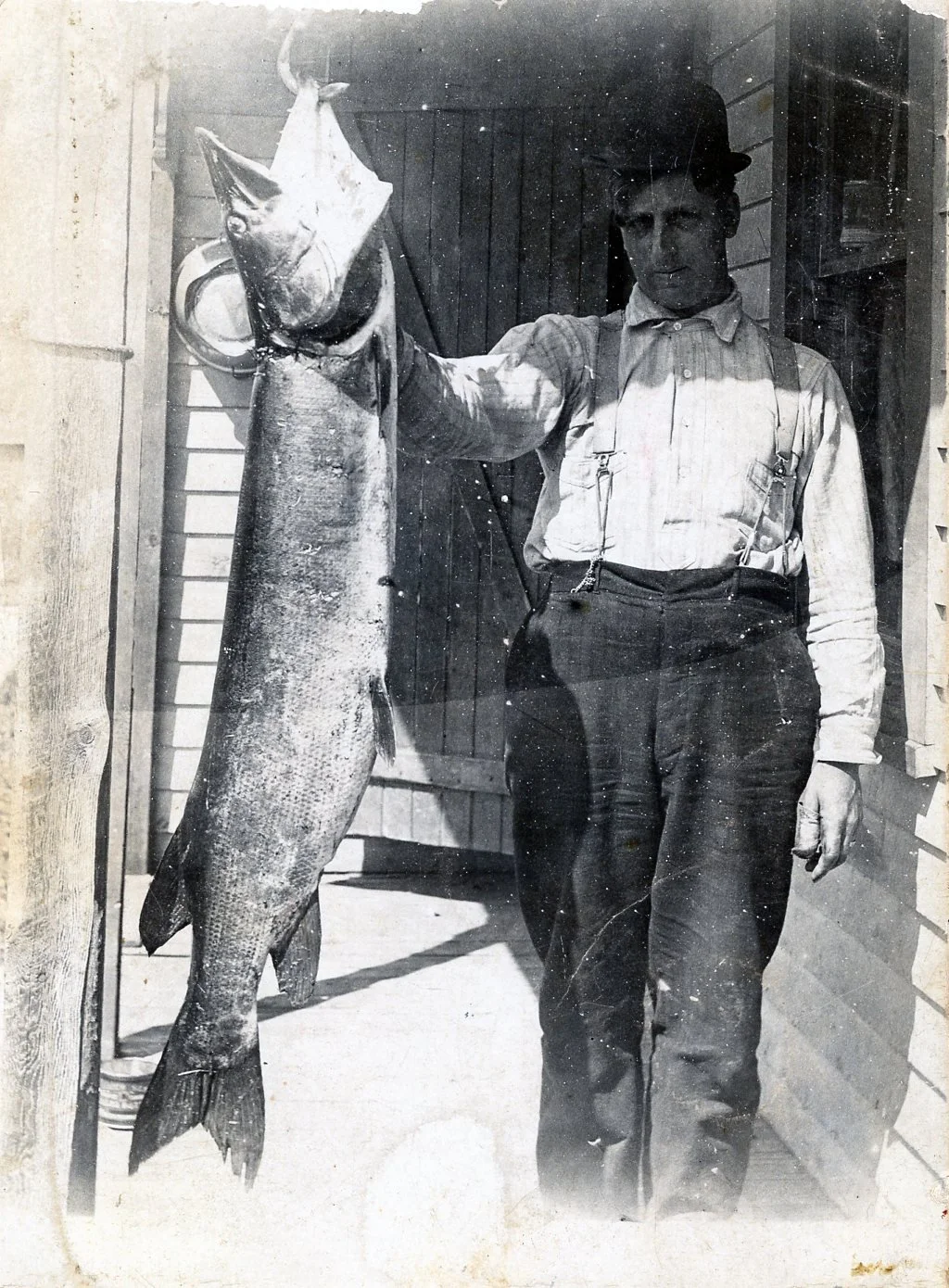
Bill Litzen and his 40 Pound Muskie
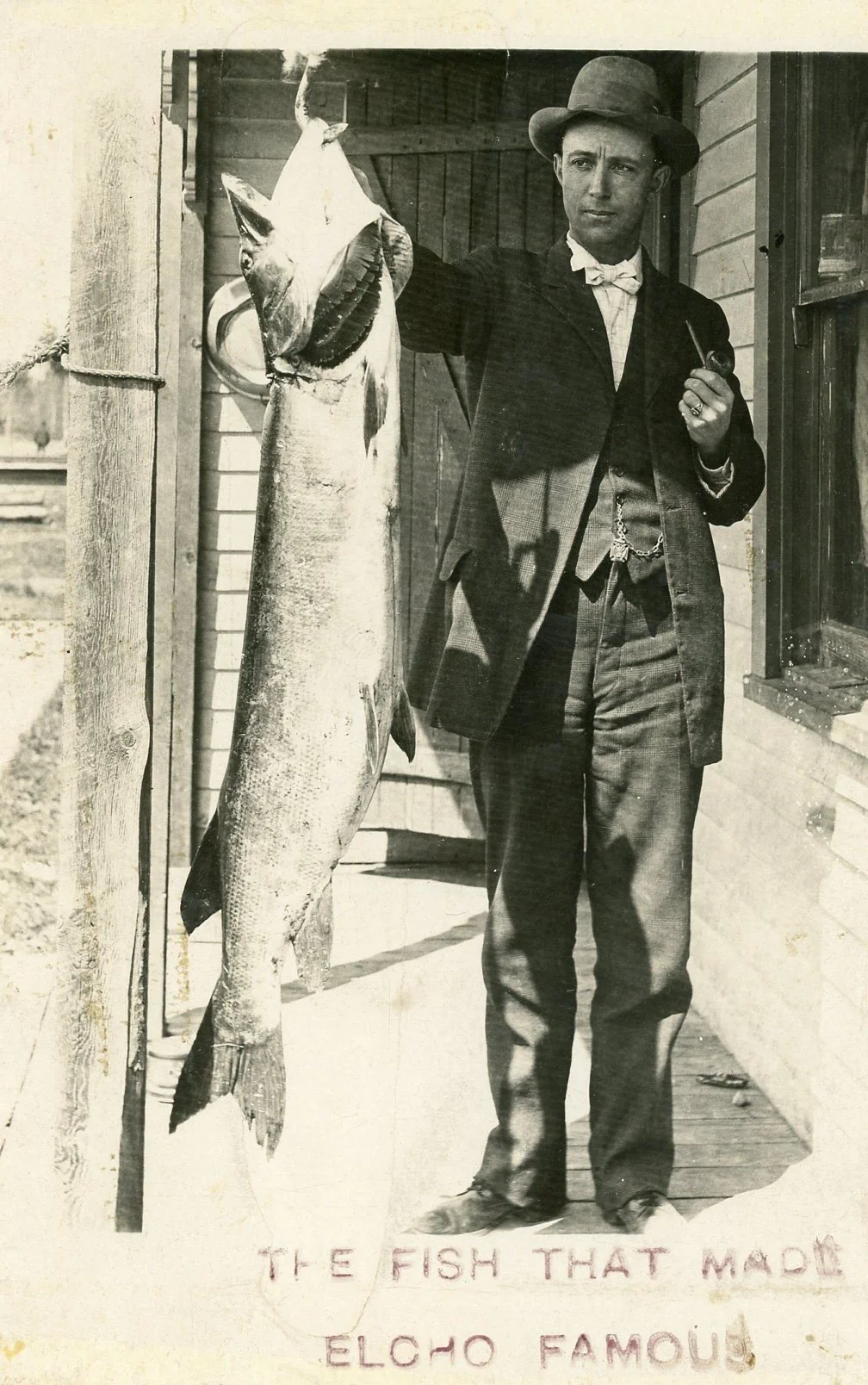
The Fish that made Elcho Famous
The time period of 1910-1920 in the Elcho-Pelican Lake area overall, was a time of growth and prosperity. Business opportunities abounded, people were coming and going, looking for places to settle. Based on what information we have at this time, this should give us a good look at life in this period. As with any historical investigation, pieces of information can come at any time, and fill in gaps that give us a more complete view of life here.